Guides / Flying with pets
Airline-approved pet carrier sizes in 2026: airline by airline
The maximum under-seat carrier size for Air Canada, WestJet, Porter, Flair, Air Transat, American, Delta, United, Alaska and more, plus the one rule every airline shares. And why "airline approved" on the box doesn't settle it.
Flying with pets · Published · Last checked

WayFur answer
There is no single airline-approved pet carrier size. Each airline sets its own maximum, for example 40 x 43 x 20 cm (16 x 17 x 8 in) on most Air Canada jets and 18 x 11 x 11 inches soft-sided on American, Delta and United, and on some airlines the limit changes with the aircraft. "Airline approved" on a product is the seller's claim, since IATA does not certify any carrier. Your carrier has to fit your airline's limit for your plane and still let your pet stand, sit, lie down and turn around inside.
Why "airline approved" isn't a guarantee
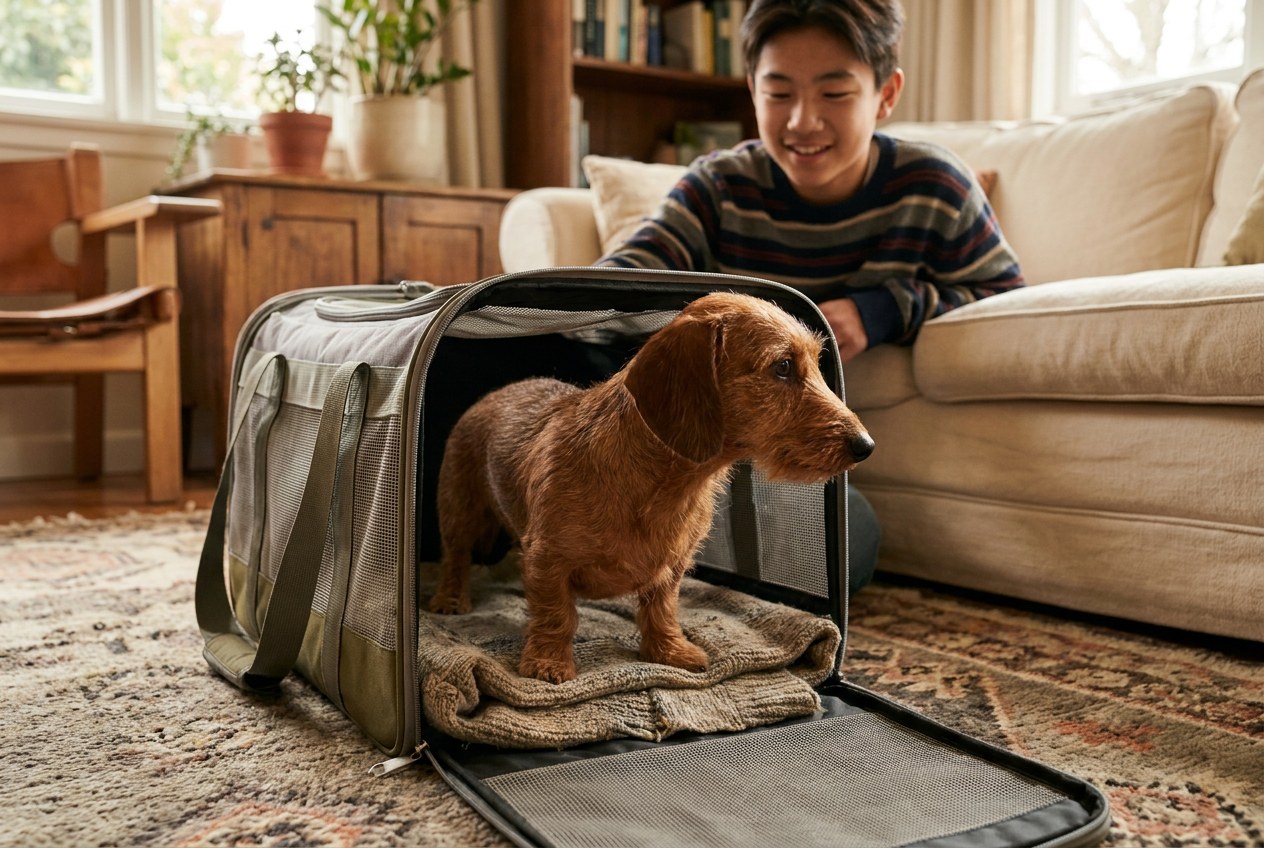
Say you live in Ottawa and you are flying to Vancouver for Christmas with your miniature dachshund. You find a roomy carrier online with "airline approved" printed across the listing, and you assume it settles the question.
It doesn't, for two reasons. The first is that nobody official approves carriers. IATA's container standard states that it does not certify, approve, endorse or sell any particular pet container maker, brand or model. It publishes standards, and the airline's check-in staff decide whether your carrier meets them. If it doesn't, IATA says the animal must not be accepted.
The second is the plane. IATA's July 2026 operational guidelines ask airlines to tell passengers about stowage limits for the specific aircraft, because under-seat space varies. The airlines show it plainly. American does not allow carry-on pets in the premium cabins of several widebody aircraft, because there is no under-seat storage there. United limits carriers to 10 inches tall on its 737 MAX. Air Canada publishes three different size limits depending on the aircraft and cabin.
Where this comes from
Sourced from IATA Live Animals Regulations, Container Requirement 1 (Edition 52, January 2026), IATA Operational Guidelines for In-Cabin Pet Transport (Edition 1, July 2026), the American Airlines pet page (read October 6, 2026) and WayFur's airline policy data for United.
The rule every airline shares
Size limits differ, but the welfare test is the same everywhere. The IATA passenger guidance asks four questions about a cabin carrier. Can your dog or cat sit up, stand up, turn around and lie down in a natural position inside it? Is at least 16% of the area on its four vertical sides ventilation? Is it escape-proof and leak-proof? Does it carry a "Live Animals" label?
Easy to miss
IATA's guidance warns that soft-sided carriers can compress when pushed under a seat, which squeezes the ventilation openings. A carrier that only fits once it is squashed flat is the wrong carrier, and the July 2026 guidelines tell check-in staff to refuse a container that does not let the pet stand, sit, lie down and turn around.
So the right carrier sits inside two limits at once. It has to be small enough for your airline's maximum and big enough for your pet to move naturally. For a long dachshund, length is the dimension to watch.
Where this comes from
Sourced from IATA, Guidance for Passengers Traveling with their Dog or Cat in the Cabin, and IATA Operational Guidelines for In-Cabin Pet Transport, section 3.1. Checked October 6, 2026.
Carrier sizes on Canadian airlines
Every Canadian airline here requires a soft-sided carrier in the cabin. On Air Canada, the aircraft matters as much as the airline: for our Ottawa to Vancouver trip, a carrier that suits a regional plane can be too tall for the jet.
Maximum cabin pet carrier sizes on Canadian airlines
| Airline | Maximum carrier size | Carrier type | Also note |
|---|---|---|---|
| Air Canada, most jets | 40 x 43 x 20 cm (16 x 17 x 8 in) | Soft-sided only | Hard kennels are refused. Carrier must be "big enough to allow them to stand up, turn around and lie down safely and comfortably". |
| Air Canada, Dash 8-400, E175, CRJ900, Landline coach | 40 x 55 x 27 cm (16 x 22 x 10 in) | Soft-sided only | More length than the jets. Carrier must be "big enough to allow them to stand up, turn around and lie down safely and comfortably". |
| Air Canada, Business on A330-300, 777, 787 | 21 x 41 x 28 cm (8 x 16 x 11 in) | Soft-sided only | The smallest Air Canada limit. Carrier must be "big enough to allow them to stand up, turn around and lie down safely and comfortably". |
| WestJet | 41 cm long, 21.5 cm high, 25.4 cm wide (16 x 8.5 x 10 in) | Soft-sided only | Pet must be "able to stand, sit, turn around, and lie down comfortably in their kennel". |
| Porter | 55 x 40 x 27 cm (21.5 x 15.5 x 10.5 in) | Soft-sided only | No part of your pet may stick out. Pet must be "small enough to fit under the seat in front of you". |
| Flair | 41 x 23 x 25 cm (16 x 9 x 10 in) | Soft-sided only | Cabin weight limit 23 lb, pet and carrier together. |
| Air Transat | 43 cm long, 24 cm wide, 25 cm high (17 x 9.5 x 10 in) | Soft-sided only | Cabin weight limit 8 kg, pet and carrier together. |
Easy to miss
Since June 1, 2025, Air Canada refuses hard kennels in the cabin, and also backpack carriers with hard plastic windows.
Where this comes from
Sourced from WayFur's airline policy data for Air Canada, WestJet, Porter and Air Transat, each taken from the airline's own pet page, and from Flair's own pet page, read October 11, 2026. WestJet's page was re-read October 6, 2026. The weight and fit notes come from each airline's own pet page, read October 12, 2026.
Carrier sizes on US and international airlines
American, Delta and United all list 18 x 11 x 11 inches for a soft-sided carrier, but each adds its own aircraft limits.
Maximum cabin pet carrier sizes on US and international airlines
| Airline | Maximum carrier size | Carrier type | Also note |
|---|---|---|---|
| American Airlines | Soft-sided 18 x 11 x 11 in (46 x 28 x 28 cm) on all flights; hard-sided 19 x 13 x 9 in mainline, 16 x 12 x 8 in American Eagle | Soft-sided recommended | No carry-on pets in premium cabins on several widebodies. Cabin weight limit 20 lb (9.07 kg), pet and carrier together, in the Airbus A321T premium cabin. |
| Delta | 18 x 11 x 11 in recommended | Soft-sided | Exact maximum depends on the aircraft; must fit fully under the seat. Pet must be "small enough to fit comfortably in a kennel with the ability to move around without touching or sticking out from the sides". |
| United | Soft-sided 18 x 11 x 11 in; hard-sided 17.5 x 12 x 9 in | Either | No more than 10 in tall on the Boeing 737 MAX. United lists "no weight or breed limitations for pets". |
| Alaska Airlines | 17 x 11 x 9.5 in | Soft-sided only | "Pets must be small enough to fit and stay comfortably in the carrier under the seat." |
| JetBlue | 17 x 12.5 x 8.5 in | Carrier "must fit under the seat in front of you". | |
| Frontier | Hard-sided 18 x 14 x 8 in; soft-sided 18 x 14 x 11 in | Either | Carrier must be "large enough for your pet to stand, turn around, and lie down naturally". |
| Allegiant | Soft-sided 18 x 12 x 11 in; hard-sided 17 x 11 x 10.5 in | Either | Pet must "have the ability to stand up and turn around". |
| Air France | 45 x 35 x 25 cm | Cabin weight limit under 8 kg (17.64 lb), pet and carrier together. | |
| KLM | 46 x 28 x 24 cm (18 x 11 x 9 in) | Cabin weight limit 8 kg (17.6 lb), with your pet inside the carrier. | |
| Turkish Airlines | 40 cm long, 30 cm wide, 23 cm high | Cabin weight limit 8 kg, pet and carrier together. |
Easy to miss
American does not allow carry-on pets in the premium cabins of the Airbus A321XLR or the Boeing 777-200, 777-300ER, 787-8 and 787-9, because there is no under-seat storage there.
Where this comes from
Sourced from WayFur's airline policy data for American, Delta, United, Alaska, Frontier, Allegiant, Air France, KLM and Turkish Airlines, each taken from the airline's own pet page, and from JetBlue's own pet page, read October 11, 2026. American's and Delta's pages were re-read October 6, 2026. The weight and fit notes come from each airline's own pet page, read October 12, 2026.
How to choose a carrier that will actually fly
Start from the airline, not the shop. Look up your airline's limit, and if it varies by aircraft, check which plane is on your flight. Then measure your pet standing up, nose to the base of the tail, and check that the carrier you like gives them room to stand, turn and lie down inside that limit.
IATA's guidance also suggests introducing your pet to the carrier well before the trip, so being inside it feels normal by the time you reach the airport. For the dachshund, that means time in the new carrier at home well before Christmas.
If your pet doesn't fit inside any cabin limit with room to move, the cabin isn't the answer. Ask your airline about flying your pet as checked baggage or cargo instead. Confirm final details with your airline before you travel.
Where this comes from
The nose to base of tail measurement comes from IATA Live Animals Regulations, Container Requirement 1, and the advice to introduce your pet to the carrier early from IATA's passenger guidance. Checked October 6, 2026.
Put in your route, date and pet, and a free readiness check shows the entry requirements at the other end, each with its source and when it was last checked.
Sources
- IATA: Live Animals Regulations, Container Requirement 1 (Edition 52)
- IATA: Guidance for Passengers Traveling with their Dog or Cat in the Cabin
- IATA: Operational Guidelines for In-Cabin Pet Transport (Edition 1, July 2026)
- Air Canada: Travelling with pets
- WestJet: Travelling with pets
- Porter Airlines: Pets
- Flair Airlines: Pets onboard
- Air Transat: Pets and service dogs
- American Airlines: Pets
- Delta Air Lines: Pet travel overview
- United Airlines: Traveling with pets
- Alaska Airlines: Pet travel Q&A
- JetBlue: Traveling with pets
- Frontier Airlines: Do you allow pets on the plane
- Allegiant Air: Traveling with pets
- Air France: Travelling with your dog or cat
- KLM: Pets, reservation
- Turkish Airlines: Traveling with pets
Common questions
What size pet carrier is airline approved?
There is no single size. Each airline sets its own maximum, such as 40 x 43 x 20 cm on most Air Canada jets or 18 x 11 x 11 inches soft-sided on American, Delta and United. Check your airline's limit for your aircraft, then confirm your pet can stand, sit, lie down and turn around inside.
What makes a pet carrier airline approved?
Only your airline's acceptance at check-in. IATA states that it does not certify, approve, endorse or sell any pet container brand or model. It publishes the standard, and the airline's staff check your carrier against it and against the airline's own size limit for your aircraft.
What type of pet carriers are airline approved?
It depends on the airline. Air Canada, WestJet, Porter, Flair, Air Transat, Alaska and Delta call for soft-sided carriers in the cabin, while American, United, Frontier and Allegiant also list a hard-sided size. A soft carrier can sometimes be a little larger, but don't count on squashing it: IATA warns that compressing a soft carrier under the seat can block its ventilation.