
GuidesBorder rules & documentation
Canada and US pet entry rules in 2026: what each border asks for, in both directions
Going into the US, a dog needs a free CDC Dog Import Form receipt, a microchip and to be at least 6 months old. Going into Canada, a dog or cat needs a valid rabies certificate. One table for both directions, dogs and cats, flying or driving.
WayFur editorial
5 min readPublished Last checked
WayFur answer
Into the US from Canada, a dog needs a free CDC Dog Import Form receipt, a microchip that a universal scanner can read, and must be at least 6 months old on the day it crosses. CDC asks no rabies proof or import form for a cat. Into Canada from the US, a dog or cat 3 months or older needs a valid rabies vaccination certificate. Both sides want a pet that looks healthy on arrival, and the rules are the same whether you fly or drive.
What each border asks for
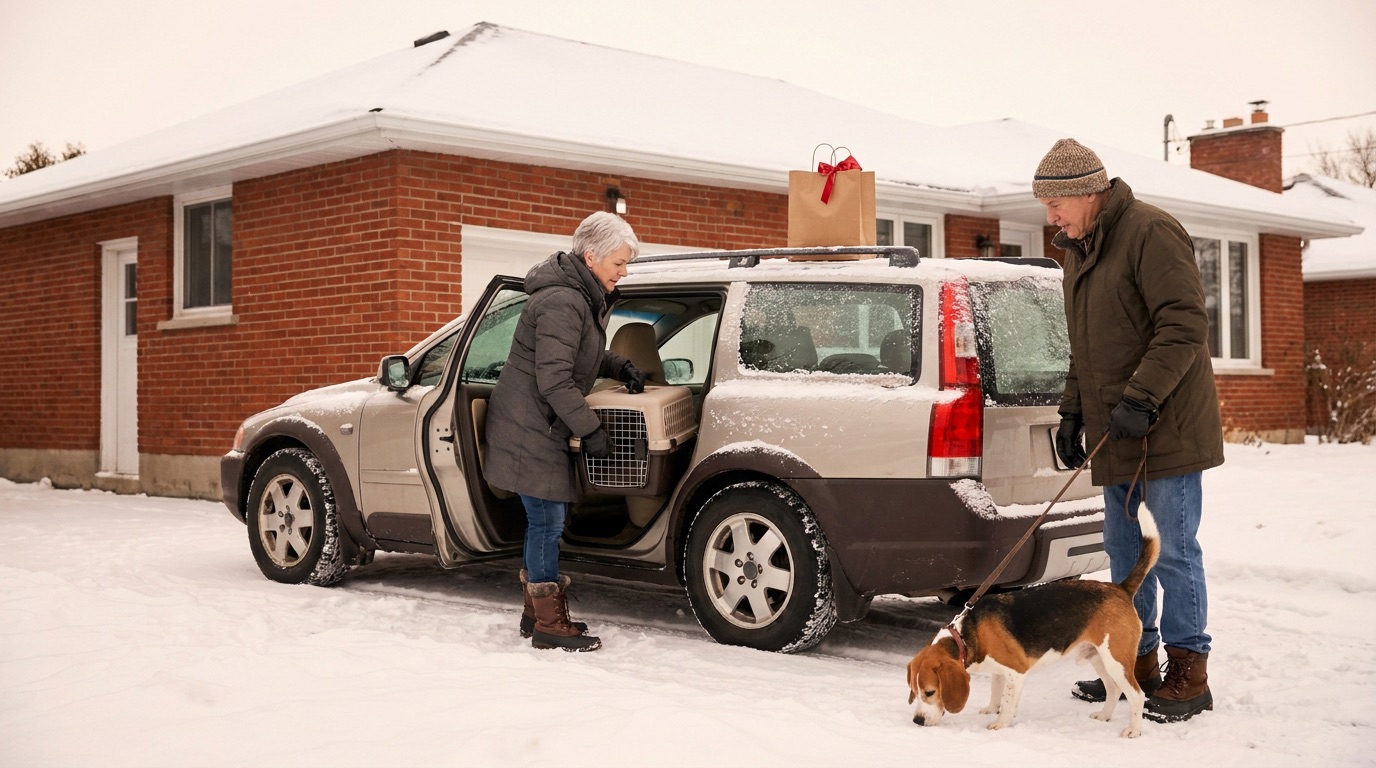
Say you and your partner live in Kingston, Ontario, and you're driving to your daughter's place in Burlington, Vermont, for the holidays. Biscuit, your 4-year-old beagle, comes along, and so does Olive, your 7-year-old cat. You cross twice, and each border asks for something different. The US Centers for Disease Control and Prevention (CDC) sets the rules for dogs going south. The Canadian Food Inspection Agency (CFIA) sets them for pets coming home.
What each side asks for from a pet dog or cat on a Canada and US trip (last checked in October 2026)
| Document or rule | Into the US from Canada (CDC) | Into Canada from the US (CFIA) |
|---|---|---|
| Import form | CDC Dog Import Form receipt, free, one per dog | None for a pet dog or cat travelling with you |
| Rabies vaccination certificate | Not listed by CDC for a dog that has only been in low-risk countries such as Canada | Valid certificate for a dog or cat 3 months or older |
| Microchip | Required for dogs, readable by a universal scanner | Not required for a pet dog |
| Age | Dogs at least 6 months old on the day of entry | Under 3 months, proof of age instead of a rabies certificate (from a vet, for a dog) |
| Health certificate | Not required by CDC | Only for a dog under 8 months travelling without its owner, from a vet exam in the 72 hours before arrival |
| Cats | No rabies proof, health certificate or import form from CDC | Rabies certificate from 3 months, proof of age before that |
| On arrival | Pet looks healthy | Pet looks healthy; a dog also travels in humane conditions |
For Biscuit, that means a CDC receipt and a working microchip on the way south, and a rabies certificate that is still valid on the day you come home. Olive needs nothing from CDC, but she needs her own rabies certificate to come back into Canada. If a Canadian rabies certificate doesn't say how long the vaccine lasts, Canada treats it as valid for 1 year from the vaccination date, so check it against your return date, not the day you leave.
Easy to miss
Coming home, you follow the other country's rules. CDC says dogs "must be at least 6 months old at time of entry or return to the U.S.", so an American dog coming back from a weekend in Montreal needs the CDC receipt too.
Why the two directions don't mirror each other
The two agencies check for different things. CDC sorts dogs by the rabies risk of the countries they've been in during the last 6 months. Its rule for finding out: "Only high-risk countries are listed on the website. If the country is not listed on the website, it is considered a dog rabies-free or low-risk country." Canada is not on the list, so a dog coming from Canada follows the simpler low-risk path, which is about identity and age rather than vaccination.
Canada checks the vaccination itself. CFIA says that pet dogs and cats arriving in Canada "will have a documentary inspection by the Canada Border Services Agency (CBSA) to ensure the animal's rabies vaccination is valid and the animal description matches."
Easy to miss
The simple US path only holds if your dog has been in low-risk countries for the 6 months before it enters the US. CDC says that if your dog has been in a high-risk country in that time, you follow the stricter rules for dogs from high-risk countries, even when you arrive from Canada.
Where this comes from
CDC, Entry Requirements for Dogs from Dog-Rabies Free or Low-Risk Countries, Bringing a Dog into the U.S. and, for cats, Bringing an Animal into the U.S., last checked on October 18, 2026. CFIA's pet import tool for dogs and cats from the US, and USDA APHIS, Pet Travel From the United States to Canada, both last checked on October 18, 2026.
Flying or driving: the same entry rules
The border rules don't change with how you travel. What changes is who else checks.
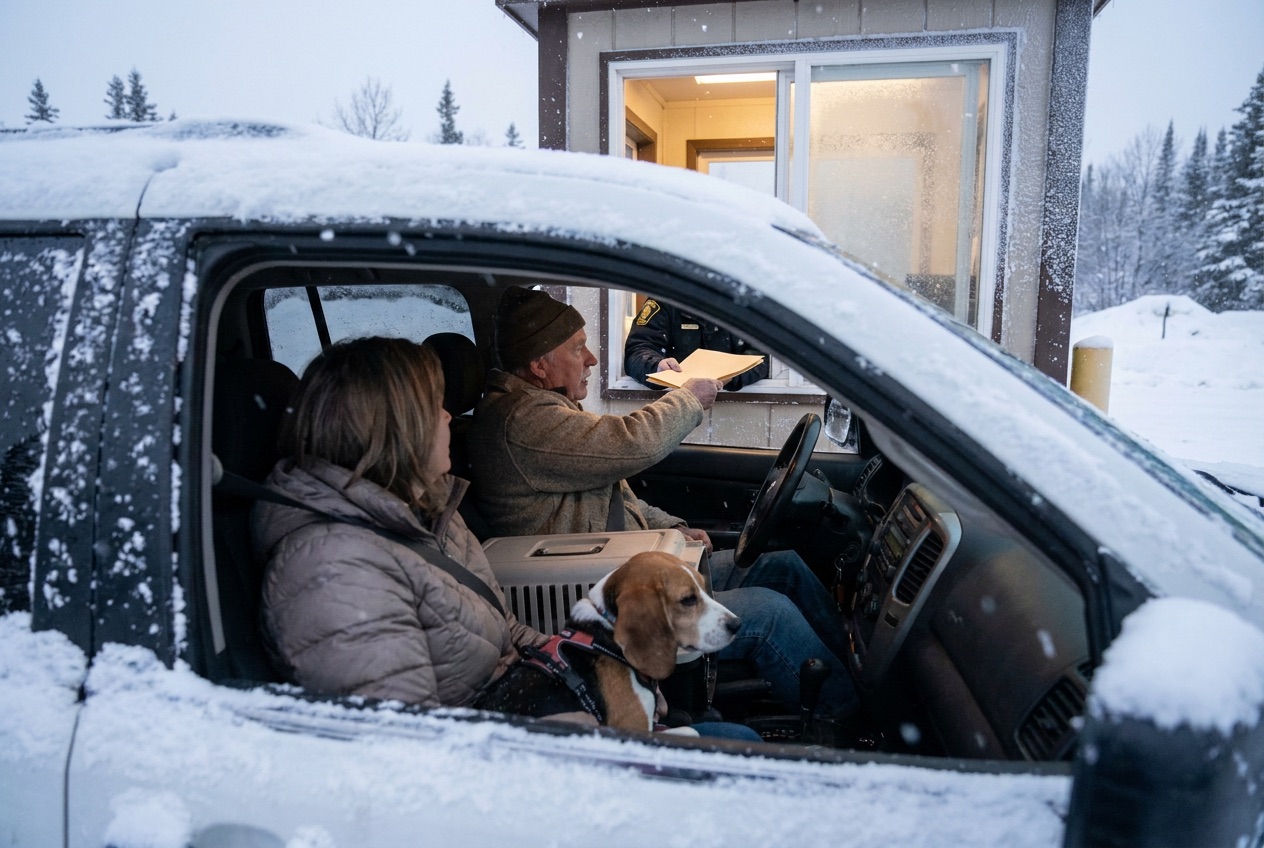
- Driving. CDC says dogs that have only been in low-risk countries "can enter the U.S. at any airport, seaport, or land border crossing." On the way back, the CBSA officer at the booth checks the rabies certificate and looks at your pet. Declare your pets when you pull up.
- Flying. The airline adds its own rules on top, and some check the border paperwork before you board. Delta, for one, says "All dogs must be accompanied by a receipt of a completed CDC Dog Import Form." Each airline also sets its own minimum age and carrier limits for a pet in the cabin. Our guide to flying with a pet in the cabin covers those.
The rules under the border: province, city and state
Federal entry is only the first gate. In Canada, some breed rules are set by the province or the city. Ontario's Dog Owners' Liability Act bans importing a pit bull into the province, and Winnipeg bans some breeds by city bylaw. Our guide to travelling with a pit bull-type dog in Canada covers where those rules apply.
In the US, CDC tells cat owners that some states require a health certificate, so check the state you're going to. Hawaii and Guam have their own quarantine rules for dogs and cats, so plan those trips well ahead.
A WayFur readiness check lists the entry requirements for your route, pet and dates, with the official source for each border's rules.
Which guide covers your crossing
- A dog going from Canada into the US: our guide to the CDC Dog Import Form covers the receipt, how long it lasts and the 6-month age rule.
- A dog going from the US into Canada: our guide to bringing your dog into Canada from the US covers CFIA's age brackets, the rabies certificate and the pet food rule.
- A long winter stay in the US: our guide to wintering in the US with your pet covers a season south.
- Travel beyond Canada and the US: our guide to pet health certificates and dog passports covers the paperwork other countries ask for.
Put in your route, date and pet, and a free readiness check lists the entry requirements for your direction of travel, with each border's source and how recently it was verified.
Sources
- CDC: Entry Requirements for Dogs from Dog-Rabies Free or Low-Risk Countries
- CDC: Bringing a Dog into the U.S.
- CDC: Bringing an Animal into the U.S.
- Canadian Food Inspection Agency: Bringing animals to Canada, importing and travelling with pets
- USDA APHIS: Pet Travel From the United States to Canada
- Government of Ontario (e-Laws): Dog Owners' Liability Act, R.S.O. 1990, c. D.16
- City of Winnipeg: Prohibited animals, Responsible Pet Ownership By-law
Common questions
What do I need to bring my dog from Canada to the US?
A free CDC Dog Import Form receipt, a microchip that a universal scanner can read, and a dog at least 6 months old on the day it crosses. The dog must also look healthy when it arrives. The same rules apply by car or by plane, and to American dogs coming home from Canada.
What do I need to bring my dog or cat into Canada from the US?
For a dog or cat 3 months or older travelling with you, a valid rabies vaccination certificate and a pet that looks healthy on arrival. A pet under 3 months needs proof of its age instead. A dog under 8 months travelling without its owner also needs a vet health certificate from an exam in the 72 hours before it arrives.
Do cats need paperwork to cross the Canada-US border?
Going into the US, CDC asks no rabies proof, health certificate or import form for a cat, though your destination state may have its own rules. Going into Canada, a cat 3 months or older needs a valid rabies vaccination certificate.
Do I need a health certificate to cross the border with my pet?
Not for a pet travelling with you in either direction under the federal rules. Canada asks for one only for a dog under 8 months travelling without its owner. Some US states and some airlines ask for one, so check your destination state and your airline.
Are the rules different if I drive instead of fly?
No. The CDC and CFIA rules are the same at a land crossing and at an airport. Flying adds the airline's own pet rules, such as a minimum age and carrier limits for the cabin.
More like this
See all guides Travelling with a pit bull-type dog in Canada in 2026: Ontario and Winnipeg rulesOntario bans importing pit bulls under provincial law, and the law has no exemption for visitors or for driving through, apart from registered show and flyball dogs. Winnipeg bans three breeds by bylaw but offers a temporary permit to travel through.
 Flying with a pet in the cabin in 2026: how it works, from booking to landingHow flying with a dog or cat in the cabin works, step by step: whether your pet is eligible, booking its spot, the carrier, airport security, the flight and landing. Based on IATA's July 2026 guidelines and the airlines' own pages.