Guides / Road trips with pets
Road trip with a dog in 2026: how often to stop, and where they can go
WayFur's road trip plan pauses for your dog every three hours and plans six hours of driving a day, and you can change both. How the stops work, how to keep your dog safe between them, and the rules where you stop.
Road trips with pets · Published · Last checked
WayFur answer
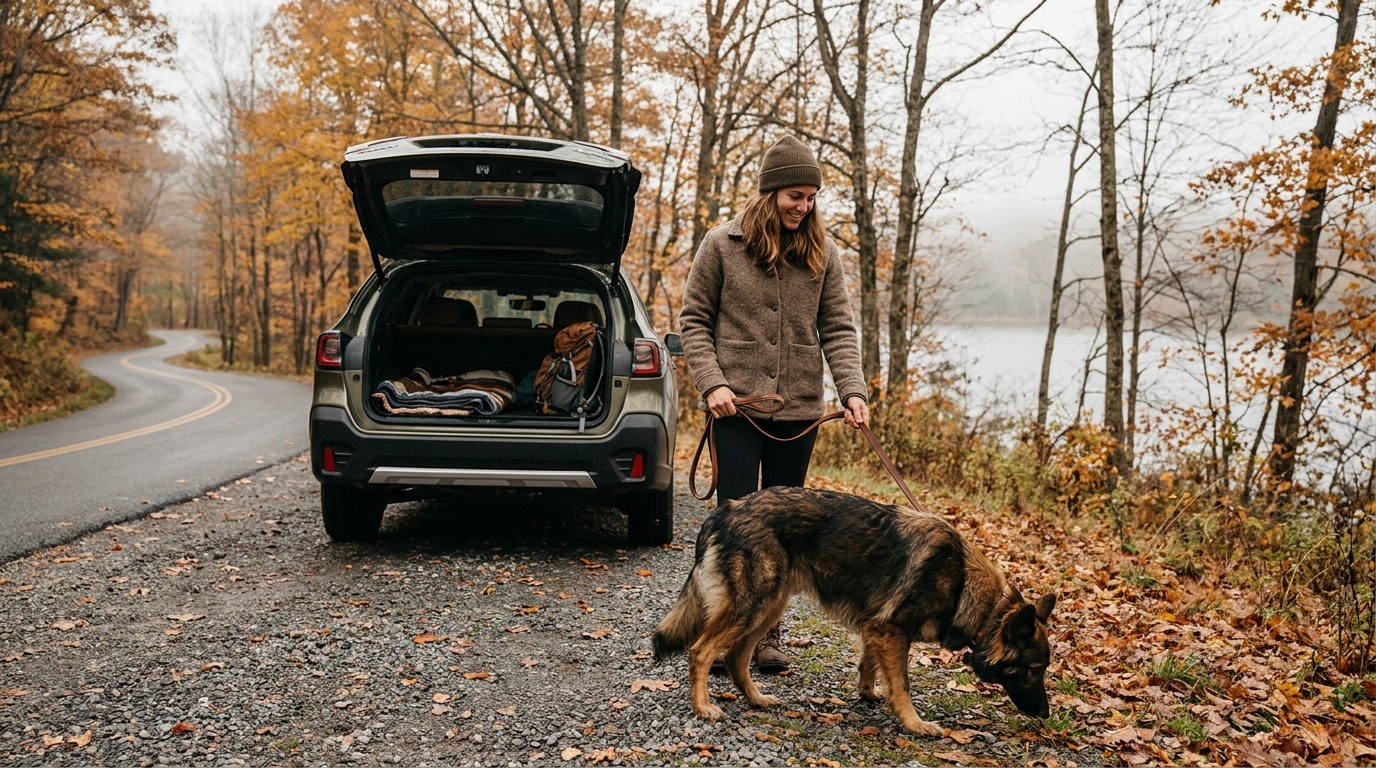
WayFur's road trip plan starts every drive with a pause for your dog every three hours and six hours of driving a day. You can change both: breaks every two, three or four hours, and a driving day of four, six or eight-plus hours, or a distance in kilometres. Each pause is 15 minutes for relief, water and a short walk, at a park or rest area near that point on your route when the plan can find one. Puppies, older dogs and dogs with health conditions may need shorter gaps, so ask your vet. Between stops, keep your dog restrained in the back seat, and never leave them alone in a parked car.
How often to stop with a dog
Say you are driving from Toronto to Winnipeg in early November, on your own, with Moose, a 65 lb shepherd mix. It is a drive of several days, much of it along the north shore of Lake Superior, with long gaps between towns. The question everyone asks first is how often Moose needs to get out.
A WayFur road trip plan answers that before you leave. Every trip starts with a pause every three hours and six hours of driving a day. You can set breaks every two, three or four hours, and a driving day of four, six or eight-plus hours, or a distance in kilometres if that is how you think about a day. Each driving day is then built from your actual route, split at the pace you chose.
Start with that pace and adjust it for your dog. A puppy, an older dog or a dog with a health condition may need shorter gaps, so ask your vet, and stop sooner if your dog starts pacing, whining or getting restless. The American Kennel Club (AKC)'s advice fits that pace: "stop every few hours to give your dog a chance to go," and plan your route so there are appropriate rest stops along the way. On a stretch with few services, like the highway along Lake Superior, knowing where the next safe place to pull over is matters more than the exact interval.
What each pause in your plan looks like
Each pause is 15 minutes: time for relief, water and a short walk. The plan looks up a park or rest area near that point on your route on Google Places. When it finds one, the stop is marked "Found on Google Places. Check it is open and welcomes pets when you arrive." When it finds none, the plan says so, and that any safe verge or lot will do. It doesn't vouch for any place it lists, so treat each one as a lead to check.
The plan also lists fuel or charging stops along the way, and where the day ends it searches for a pet-friendly stay if you need one. Each driving day starts with a reminder to feed your dog and take a last walk before setting off.
What a good bathroom stop looks like
The stop itself is where most things go wrong, and almost none of it is complicated.
Leash first, door second. Clip the leash on before you open the car door. Even a calm dog can bolt somewhere new, and a highway pull-off is the worst place for it. The Humane Society (Humane World for Animals) recommends a leash clipped to a collar or harness your dog can't wiggle out of.
Bags, water and a bowl. The AKC calls poop bags "an essential item you should always have on hand," and suggests carrying fresh, clean water and a portable dish so you can offer your dog a drink along the way. Keep them within reach, not packed under the luggage.
Feed lightly, and early. The ASPCA suggests a light meal three to four hours before you leave, and no feeding in a moving vehicle. The big meal waits until you stop for the night. Your vet can tell you what suits your dog.
ID on the dog. The ASPCA recommends a microchip and a collar tag with your name and phone number. Keep the microchip registered with your current contact details. If Moose bolts at a gas station 400 km from home, that tag is how he gets back to you.
If your dog gets car sick. Short, pleasant practice drives before the trip can help. For anything beyond that, talk to your vet.
Between stops: restraint basics
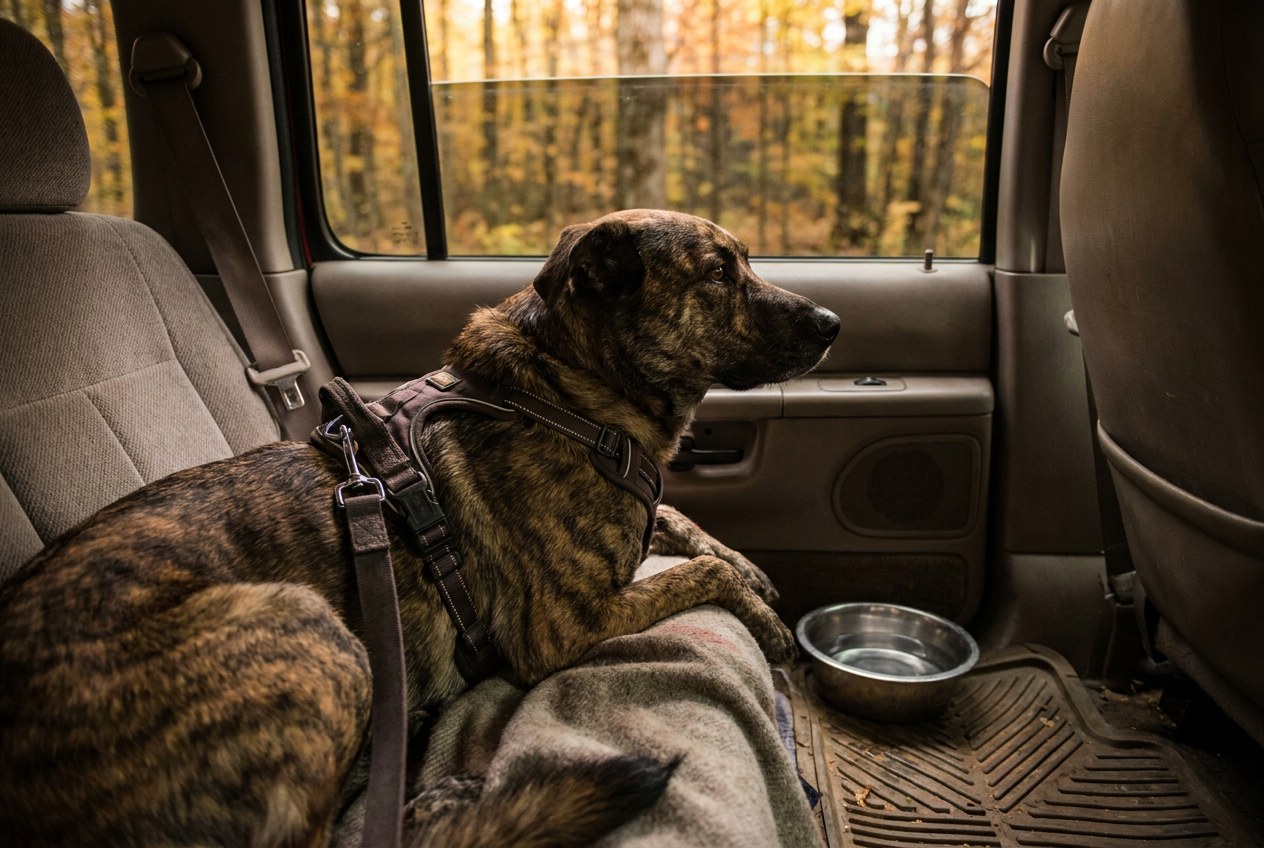
A loose dog in a moving car is a risk to the dog and to you. The American Veterinary Medical Association (AVMA) says pets should always be properly restrained, "using an appropriate safety harness, crate, or carrier," and warns that in a collision unrestrained pets "may be crushed by deployed airbags, or thrown out or through windows or windshields." It suggests crash-tested harnesses that work with your seat belt, or a crate secured as close to the centre of the vehicle as possible. Keep your dog's head inside the car, too: the AVMA lists flying debris, being thrown on a sudden stop and jumping out as the risks.
For a 65 lb dog like Moose, that usually means a harness clipped to the rear seat belt or a crate anchored in the cargo area.
Where this comes from
The pace, pause and stop details describe how a WayFur road trip plan builds each driving day. The stop, bag and water advice is from the American Kennel Club, the feeding and ID advice from the ASPCA, and the leash advice from the Humane Society (Humane World for Animals), all read on 2026-10-07. The restraint and parked-car guidance is from the AVMA, read on 2026-10-06. It is advice, not law.
Planning where your dog can actually go
Stops are only half the plan. The other half is the places you leave the car for longer: lunch, a motel, a night with friends.
Never leave your dog in the car. The AVMA cites research showing a car's interior "can rise about 20 degrees Fahrenheit in just 10 minutes, and almost 30 degrees in 20 minutes," and says cracking the windows makes no difference. Cold is a risk too. In Manitoba, the Animal Care Act bans leaving a pet in an unattended vehicle when it is hot or cold enough to endanger its health, and presumes that whenever it is above 22 C or below minus 10 C outside, unless the climate control is on. An officer can force entry to remove the animal. Moose arrives in Winnipeg in November, so that cold threshold is a real one.
Easy to miss
Ontario has its own rule. Under the Provincial Animal Welfare Services Act, 2019, a person authorized by regulation can enter a vehicle, causing the damage reasonably needed, to help an animal in critical distress, and can take the animal. Most of Moose's drive is in Ontario.
Book stays that take your actual dog. Many pet-friendly hotels set weight limits, and they vary by chain and by property, so a 65 lb dog can be welcome at one and turned away at the next.
Know the rules where you stop. Breed law can change at a city or provincial line. Ontario restricts pit bull-type dogs province-wide, and Winnipeg bans several breeds by bylaw. A shepherd mix is not on either list, but if your dog is a bully breed, check both before you plan the route. Our guide to pet-friendly stops on a long drive covers the rest.
Where this comes from
The Manitoba and Ontario vehicle rules and the Ontario and Winnipeg breed rules come from WayFur's verified policy data (The Animal Care Act s.5.4; Provincial Animal Welfare Services Act, 2019 s.34; Dog Owners' Liability Act; Winnipeg Responsible Pet Ownership By-law), last verified between July and October 2026.
Check your own trip
Enter your start, your destination, your date and your dog. A free readiness check covers the entry rules and paperwork for your destination, and for coming home on a round trip, with the sources behind them, plus breed law where the trip starts and ends. For any long drive, look up the rules for the towns and provinces you pass through too. A WayFur trip plan then lays out each driving day at your pace, with pauses for your dog, fuel stops and a pet-friendly stay where the day ends.
Sources
- Government of Manitoba: The Animal Care Act, C.C.S.M. c. A84, section 5.4
- Legislative Assembly of Ontario: Provincial Animal Welfare Services Act, 2019 (Bill 136, as enacted)
- Government of Ontario (e-Laws): Dog Owners' Liability Act, R.S.O. 1990, c. D.16
- Government of Ontario (e-Laws): O. Reg. 157/05, Pit Bulls
- City of Winnipeg: Prohibited animals
Common questions
How often should you stop on a road trip with a dog?
A WayFur road trip plan pauses every three hours by default, with 15 minutes for relief, water and a short walk, and you can set it to every two or four hours instead. Puppies, older dogs and dogs with health conditions may need shorter gaps, so talk to your vet about your own dog, and watch for pacing, whining or restlessness as a sign to stop sooner.
How many hours a day should you drive with a dog?
A WayFur road trip plan starts at six hours of driving a day. You can change it to four or eight-plus hours, or set a distance in kilometres, and each driving day is split from your route at that pace.
How do I prepare for a road trip with a dog?
Feed a light meal three to four hours before you leave, as the ASPCA suggests, put an ID tag on the collar or harness and make sure the microchip details are current, pack bags, water and a bowl, and set up a crash-tested harness or secured crate in the back seat. Then choose your pace: how long you want to drive each day and how often to stop.
What are the rules for travelling with a dog in the car?
On this route, the laws to know are about leaving a dog unattended. Manitoba presumes danger above 22 C or below minus 10 C unless the climate control is on, and Ontario lets an authorized person enter a vehicle to help an animal in critical distress. The restraint guidance here is advice from the AVMA, not provincial law.
Can I leave my dog in the car for a few minutes?
The AVMA says never, whatever the outside temperature. Some provinces, Manitoba among them, set legal thresholds for heat and cold. At a gas or bathroom stop on your own, take your dog with you or have them wait with someone.