Guides / Border rules & documentation
Driving across the Canada-US border with a dog or cat in 2026: what officers check
Going south, a dog needs a CDC Dog Import Form receipt and a cat needs no federal paperwork. Coming home, Canadian officers want a valid rabies certificate that matches your dog or cat. What to have in the car for each pet.
Border rules & documentation · Published · Last checked

WayFur answer
Driving into the US from Canada, a dog needs a CDC Dog Import Form receipt, a microchip a universal scanner can read, and to be at least 6 months old. A cat needs no CDC form, rabies certificate or health certificate to enter the US, though it must look healthy and some states add rules. Driving back into Canada, a dog or cat 3 months or older needs a valid rabies vaccination certificate that matches the animal in the car. Neither direction asks for a health certificate for an adult pet travelling with its owner, and both expect the paperwork to be in the car, not at home.
What each border asks for a pet dog or cat travelling with you by car
| Crossing | Dog | Cat |
|---|---|---|
| Into the US from Canada | CDC Dog Import Form receipt, a microchip a universal scanner can read, at least 6 months old, looks healthy | No CDC import form, rabies certificate or health certificate; must look healthy; some states add rules |
| Into Canada from the US, 3 months or older | Valid rabies vaccination certificate that matches the dog | Valid rabies vaccination certificate that matches the cat |
| Into Canada from the US, under 3 months | Vet proof of the dog's age | Proof of the cat's age |
Heading south: what US officers check
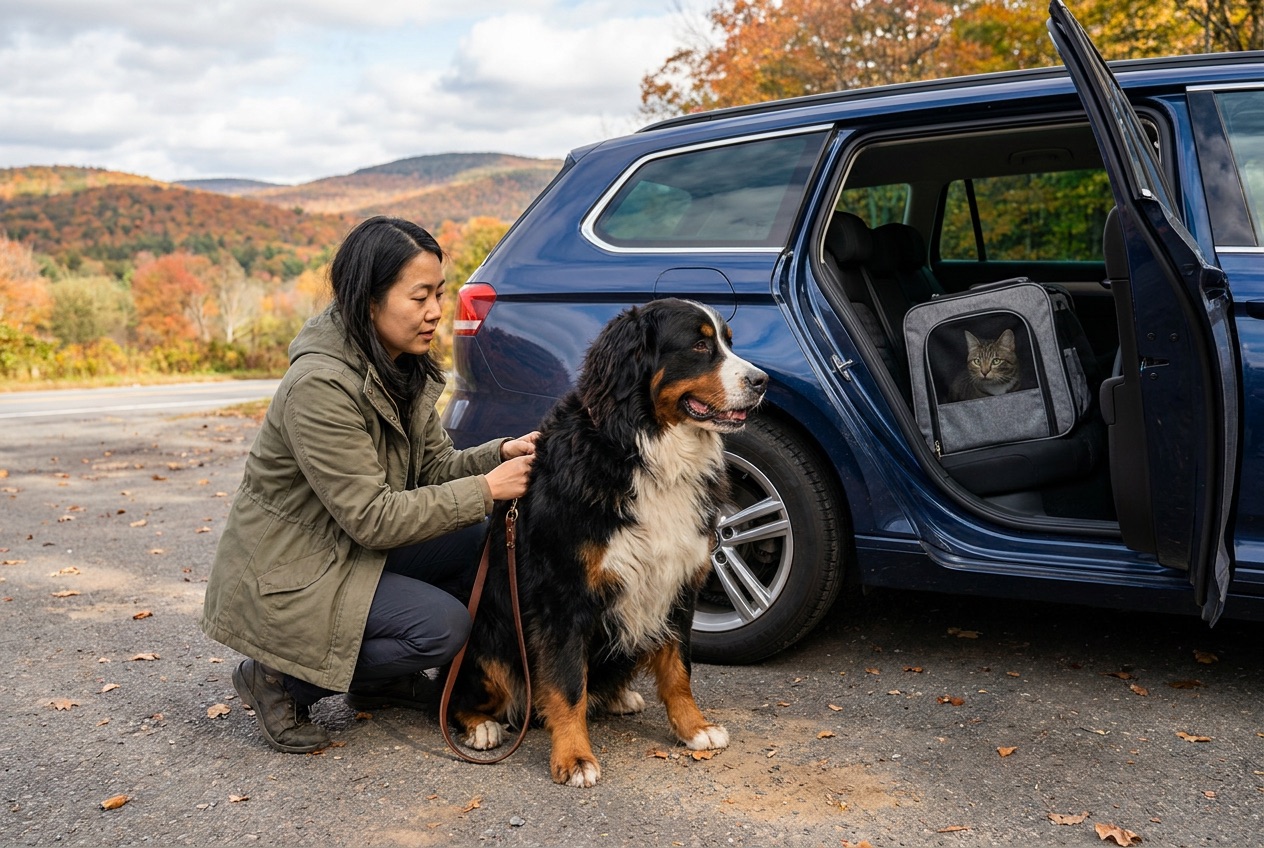
Say you live in Ottawa and you are driving to Vermont for a long weekend in November with Olive, a two-year-old Bernese mountain dog, and Miso, a five-year-old tabby cat. You will cross twice: into the US on Friday, back into Canada on Monday, and each border treats Olive and Miso differently.
Going south, the rules come from the CDC. Since August 1, 2024, the only required document for a dog coming from a low-risk country like Canada is the CDC Dog Import Form receipt. On top of the receipt, your dog must:
- be at least 6 months old on the day it enters or returns to the US
- have a microchip that can be detected with a universal scanner
- appear healthy on arrival
The form is free and online, and the CDC says you can fill it out on the day of travel, though it recommends doing it a few days ahead. Each dog needs its own form, and you can show the receipt printed or on your phone. It is valid for 6 months from when it is issued, and the CDC says it "can be used for multiple entries into the United States as long as the dog has not been in a high-risk country in the past 6 months." Visiting a different country in that time means a new form. For Olive, one receipt covers this trip and any other drive south in the next six months.
Easy to miss
A dog vaccinated outside the US that has been in a high-risk country for dog rabies in the past 6 months cannot drive in from Canada. The CDC requires it to fly directly to the US airport where it has a reservation at a CDC-registered animal care facility, with a rabies titer report and other documents.
Miso has a lighter federal rule going south. The CDC says cats "are not required to have proof of rabies vaccination for importation into the United States," there is no CDC import form for a cat, and no health certificate is required. Miso must look healthy when she arrives, and the CDC can refuse entry to a cat that shows signs of disease or require a vet exam at your cost. Some states require a health certificate for cats or have other rules, so check with the state you are driving to.
Heading home: what Canadian officers check
Coming back north, the rules are the same shape for both pets. Per the CFIA, every personal pet dog and every domestic (pet) cat "will have a documentary inspection by the Canada Border Services Agency (CBSA)": that the rabies vaccination is valid and that the animal matches the description on the certificate. The CBSA also looks at the animal.
Per the CFIA, a dog 3 months or older travelling with its owner needs a valid rabies vaccination certificate, signed by a licensed vet, in English or French, that identifies the dog (age, breed, sex, colour or markings, weight, and microchip or tattoo if it has one), identifies the owner, and shows the vaccination date, the vaccine's trade name and serial number, and how long it is valid. If the validity is not stated, Canada treats it as valid for 1 year. For an adult pet dog with you, there is no health certificate and no microchip requirement. A puppy under 3 months needs vet proof of its age instead of a rabies certificate.
A cat 3 months or older needs a valid rabies vaccination certificate with the same details: in English or French, signed by a licensed vet, identifying the cat, and showing the vaccination date, the vaccine's trade name and serial number, and how long it is valid (otherwise 1 year from the vaccination date). The CFIA also accepts a European Union pet passport that includes all of those details. A kitten under 3 months needs proof of its age instead.
On fees, the CBSA says its standard animal inspection fees do not apply to dogs, cats or ferrets arriving from the US. If an officer issues a vaccination order, though, a fee applies to animals from every country, the US included, and the CBSA can also refuse entry or detain an animal that is undeclared or lacks the right certificates. Declare Olive and Miso when you pull up.
Where this comes from
The fee rule comes from the CBSA's border fee page (last modified 31 March 2026), last checked on October 13, 2026. The cat rules come from the CFIA's pet import pages, last checked on October 13, 2026, and the CDC's page on bringing an animal into the US.
Pet food at the border
Per the CFIA, you can bring your pet's own food back into Canada, "limit of 20 kg per animal," if it is of United States origin, commercially packaged, in your possession at the crossing, and fed only to the animal travelling with you. The CBSA says you must declare all food, plant and animal products. Our guide to bringing your dog into Canada from the US covers the pet food rule in full, and the US Department of Agriculture lists what you can bring south at the Canada land border.
Practical tip
Keep the food in its original bag with the label visible. It makes the "US origin, commercially packaged" conditions easy to show if an officer asks.
What to keep in the car
Put these where you can reach them from the driver's seat, not in a suitcase in the trunk:
- The original rabies vaccination certificate for each pet, dog and cat. The CFIA strongly recommends physical originals of every document.
- The CDC Dog Import Form receipt, printed or on your phone, one per dog. Cats don't need one.
- Your dog's microchip number, so you can match it to the paperwork if asked.
- Pet food in its original, commercially packaged bag, within 20 kg per animal for the return to Canada.
- A leash on the dog and the cat in a closed carrier before any window or door opens.
Federal entry is not the only layer. Some provinces and cities set their own rules, like breed bans in Ontario and Winnipeg, and US states can add requirements for dogs that stay. Our guide to Canada-US pet entry rules covers both directions in more detail, and our guide to pet health certificates explains when a certificate does apply. Confirm final details with the CDC, the CFIA and the CBSA before you travel.
Put in your route, date and pet, and a free readiness check lists the entry requirements for your trip, with each border's source and how recently it was verified.
Sources
- US Centers for Disease Control and Prevention: Entry Requirements for Dogs from Dog-Rabies Free or Low-Risk Countries
- US Centers for Disease Control and Prevention: CDC Dog Import Form instructions
- US Centers for Disease Control and Prevention: Entry Requirements for Foreign-Vaccinated Dogs from High-Risk Countries
- Canadian Food Inspection Agency: Bringing animals into Canada (pets)
- US Centers for Disease Control and Prevention: Bringing an Animal into the U.S.
- Canadian Food Inspection Agency: Pet food personal imports
- Canada Border Services Agency: Fees for animal inspections
- Canada Border Services Agency: Bringing animals into Canada
- Canada Border Services Agency: Declaring food, plant and animal products
- USDA APHIS: Traveling between the United States and Canada by land
- Government of Ontario (e-Laws): O. Reg. 157/05 under the Dog Owners' Liability Act
- City of Winnipeg: Prohibited animals, Responsible Pet Ownership By-law
Common questions
What is required to bring a dog into the US from Canada?
A CDC Dog Import Form receipt, a microchip that a universal scanner can read, a dog at least 6 months old, and a dog that looks healthy. The form is free, can be done online on the day you travel, and covers repeat entries from Canada for 6 months.
What documents do I need to bring a dog into Canada?
For a dog 3 months or older travelling with you, a valid rabies vaccination certificate that matches the dog. The CBSA checks it at the crossing and looks at the dog. A puppy under 3 months needs vet proof of its age instead.
Can I drive across the Canada-US border with my cat?
Yes. Going into the US, the CDC asks for no import form, rabies certificate or health certificate for a cat, but the cat must look healthy and some states add rules. Coming into Canada, a cat 3 months or older needs a valid rabies vaccination certificate that matches it, and a kitten under 3 months needs proof of its age.
Does a cat need a rabies certificate to enter the US from Canada?
Not under federal rules. The CDC says cats are not required to have proof of rabies vaccination to enter the US. Some states require a health certificate or other documents, so check the rules of the state you are driving to, and keep the rabies certificate with you for the drive back into Canada.